
Curso LGPD in action
LGPD in Action Course
This page brings together the promotional text of edition 2021-1, kept as a historical record. Registration is closed. The course was taught in Portuguese.
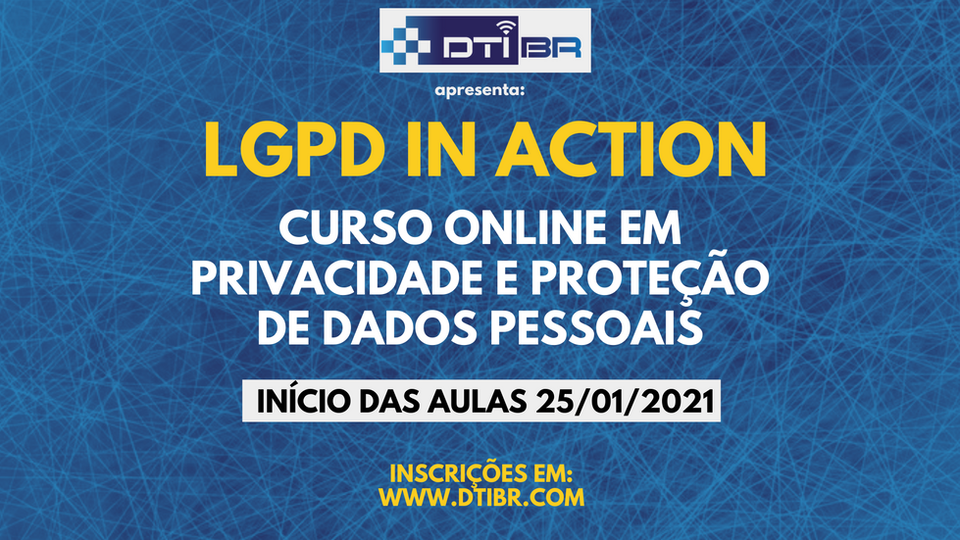
Description
Have you already studied the LGPD (Brazil's General Data Protection Law) but are unsure how to apply it in practice? Do you still not feel fully confident carrying out a personal data protection compliance process? After consulting around 300 former students, we are launching a distinctive course. Focused on the practical application of the LGPD across the various phases of the compliance process, the course faculty will analyze, live, drafts of the main documents and software used.
There are 08 (eight) independent online modules, each on a specific subject, which can be taken individually or together. The promotional combo includes all course modules at a substantial discount and also grants, as an exclusive complimentary benefit, participation in the closing discussion session with one of the Directors of the ANPD (Brazil's National Data Protection Authority).
Highly qualified faculty with solid practical experience in the field.
What sets the course apart
Meticulously planned, with Centro DTIBR's quality standard. Average satisfaction rate among former students of 90%. Focus on the practical side of each topic, including the analysis of drafts of the main documents and software used in the market.
Highly qualified faculty with solid practical experience in the field.
Centro DTIBR's commitment to ethical and inclusive values, reflected in a price far below the usual market rate, especially when purchasing the full course (Combo of 08 modules + complimentary Talk on the ANPD).
Target audience
Professionals from any background or field, in the public or private sector, who already work in practice with personal data protection and compliance projects, since prior knowledge of the basic concepts of the subject and of the text of the LGPD is required.
Since the course will offer an in-depth study of data protection, those who may not have prior experience with the subject should take Module 1, which introduces the concepts and levels the group.
Content, dates and times
The course comprises the modules listed below. All classes will be live, from 7:00 pm to 9:50 pm (Brasília time).
Module 1 - Introduction to Personal Data Protection and Leveling - January 25. Prof. Leonardo Parentoni
Module recommended for those who have not yet studied the LGPD or have little knowledge of the subject. It is intended to level the course participants so that they can properly follow the other modules, which require good knowledge of the subject, since they are specifically aimed at deepening and applying each topic in practice, with analysis of drafts of the main documents and software used.
Module 2 - Data Protection, Human Resources and Employment Contracts - January 27. Prof. Rômulo Valentini
Background checks: purpose and limits in case law; Prohibited conduct in job interviews; Main legal bases in the employment contract; Compliance with LGPD principles in employment relationships; Life cycle of employee data; Technological tools commonly used in employment contracts: limits and prevention of harassment; Duties of the DPO and job reassignment beyond the role.
Module 3 - Contracts with Suppliers and Consumers - January 29. Prof. Julia D'Agostini Maciel; Prof. Yuri Santos
Data protection from the perspective of Private Law: fundamental concepts, contracts and the LGPD; Data protection in the B2C context: identifying processing agents (controller and processor), relationships between these agents and data subjects; Contractual clauses with consumers: essential elements (transparency, accountability, data subject rights, communication); “Dos and don’ts” in practical examples; Design, UX and adherence to general terms; Data protection in the B2B context: responsibilities among different processing agents, shared use of personal data; Contractual clauses with suppliers: essential elements, “dos and don’ts” in practical examples.
Module 4 - Theory and Practice of Legal Bases, with a Focus on Legitimate Interest - February 1. Prof. Leonardo Parentoni
Legal bases: concept, purposes, pre- and post-LGPD scenarios, overview, common mistakes; Legitimate interest: concept, purposes, practical importance, cases where it applies and challenges; Proportionality test for legitimate interest (art. 10 of the LGPD); When not to rely on legitimate interest; Legitimate interest assessment: what it is, what it is for, how to build one in practice, analysis of drafts of this type of document.
Module 5 - International data transfers in practice - February 3. Prof. Maria Cecília Gomes
Purpose and rationale of international data transfers; Draft consent form for international data transfers; SCCs and BCRs; Public/state instruments: adequacy decisions and international cooperation; Practical analysis of Brazilian and foreign drafts of these mechanisms; Would Brazil currently meet the requirements for an adequacy decision?
Module 6 - Programmatic Media, Marketing and Personal Data Protection - February 5. Prof. Ana Flávia Costa Ferreira
Programmatic media: what it is, what it is for, how it works; Buying flow and players in the programmatic media chain, impression buying models; Programmatic media and data flows: “cookies, first party and third party data”; Marketing under the LGPD: brief background on the subject, the most applicable principles and commonly used legal bases; Use of legitimate interest in advertising, with a focus on practical cases; Consent in advertising, with a focus on practical cases; Email marketing.
Module 7 - DPO in action: The day-to-day work of a data protection officer - February 8. Prof. Débora Batista Araújo
How did you become a DPO? At which company did/do you carry out the compliance process: size, field of activity, client profile, etc.? What was the pre-compliance scenario like and what is it like today? What changed in practice? Main challenges of the compliance process: cultural, technical, financial and organizational barriers encountered; How long did the compliance process take and what were its main phases? Tools and software used; How are the personal data protection policy monitored and enforced? How to structure the DPO's day-to-day work? How to implement Privacy by Design efficiently? How to deliver results given that Privacy Governance topics involve many areas (depending on the size of the company)? Is it worth being a DPO in Brazil? Advice for those who intend to take on this role.
Module 8 - Software Supporting Data Protection Compliance Programs - February 9. Prof. Fernando A. Santiago Júnior
What is software supporting personal data protection programs and what is it for? Which stages of the compliance process does it apply to? In what way? Advantages and disadvantages of using these tools; Reference to some of the main software on the market; Average cost of this software; Demonstration of how to use one of them in practice; Is it possible to carry out a good LGPD compliance project without using software?
Exclusive complimentary session for combo buyers (full course) - Talk on the ANPD: Effective establishment, first challenges and outlook - February 10. 1 hour long. Prof. Miriam Wimmer
Who the first Directors of the ANPD are and what their profile is; Effective establishment and current stage of the ANPD's activities (structural and staffing aspects and preparation of documents); Challenges and difficulties faced so far; The ANPD's list of priorities for the short and medium term; What to expect from it in the long term?
Faculty bios
Attorney. Certified DPO from Maastricht University (Netherlands). Specialist in Contracts from PUC/SP. Specialist in Economic and Business Law from FGV/SP and in Corporate Law from Insper. DPO of Claro in Brazil.

Fernando A. Santiago
Attorney. Appointed by the Chamber of Deputies to the National Council for Personal Data Protection and Privacy. PhD and Master's in Public Law from Université de Paris 1 (Panthéon-Sorbonne). Studied International Law at Cornell Law School (USA) and Negotiation Techniques at Harvard Law School (USA).
Founder and Scientific Coordinator of Centro DTIBR. PhD in Law from USP (University of São Paulo). Master's in Business Law from UFMG (Federal University of Minas Gerais). Adjunct Professor of Business Law at UFMG and Full Professor at IBMEC/MG. Founder and Coordinator of the Law, Technology and Innovation concentration area in the Graduate Program of the UFMG Law School. Visiting Researcher at the University of Texas at Austin (USA) and at the Data Protection Agency of Uruguay.
Researcher and Data Protection Project Lead at FGV/SP. Was a visiting researcher at the European Data Protection Supervisor (EDPS) and at the Data Protection Unit of the Council of Europe (CoE). Master's candidate in Philosophy and General Theory of Law at USP. Postgraduate degree in Intellectual Property and New Business from FGV. Attorney specializing in Privacy and Data Protection.
PhD in Law from UFMG. Guest Professor in the Graduate Program in Law at UFMG. Member of the Board of Centro DTIBR. Professor in the Graduate Program in Law and Technology at Faculdade Arnaldo. Professor in the MBA in Digital Compliance at PUC/MG. Judicial Analyst at the TRT (Regional Labor Court) of the 3rd Region. Member of the PJe GNN at the CSJT (Superior Council of Labor Justice) in 2017.
Attorney. President and CEO of Centro DTIBR. Law degree from UFMG, with an academic exchange at the University of Ljubljana (Univerza v Ljubljani), Slovenia. Master's candidate in Computer Science at UFMG. Works with social computing, machine learning and data science.
Attorney and Master's candidate in Law at UFMG. Researcher at Centro DTIBR. Attended the Internet Governance School of the Brazilian Internet Steering Committee, and was a fellow of the Youth@IGF program of the Brazilian Internet Steering Committee (CGI.br) and of the 9th South School on Internet Governance (SSIG).

Ana Flávia Costa Ferreira
Attorney with a law degree from UFMG, including an academic exchange at Johannes Gutenberg-Universität Mainz, Germany. Postgraduate degree in Intellectual Property and New Business from FGV-Law. Specializes in Digital Media, Advertising and Entertainment. Holds the IAB Brasil Digital Fundamentals Certification.

Special guest
Miriam Wimmer (opens in a new tab)
Director of the ANPD. PhD in Communication and Culture Policies from UnB (University of Brasília). Master's in Public Law from UERJ (Rio de Janeiro State University). Held various leadership positions at the MCTIC (Brazilian Ministry of Science, Technology, Innovation and Communications), where she coordinated the drafting of the Brazilian Digital Transformation Strategy.


NOTE: Dr. Miriam Wimmer's participation is voluntary and unpaid.
Method
Each module will be taught live and online, with a focus on the practical application of the topics and analysis of drafts of the main documents and software used.
Certificate
Centro DTIBR will issue a certificate. If one or a few modules are purchased separately, an individual certificate will be issued for each module actually attended. If the full course is purchased (Combo of 08 modules + complimentary Talk on the ANPD), a single certificate will be issued to students who attend at least 05 modules (equivalent to approximately 60% of the course). The certificate will bear the name entered on the Sympla platform at registration, and later corrections will not be accepted. Therefore, before registering, set your name on the Sympla platform as you would like it to appear on the certificate. Certificates will be sent within 30 (thirty) days after the last module of the course.
General information
- Workload
- 25 class hours.
- Live class dates
- Jan 25; Jan 27; Jan 29; Feb 1; Feb 3; Feb 5; Feb 8; Feb 9; Feb 10
- Venue
- online platform to be announced by email to registered students.
Registration terms at the time
Fees and rules published when the edition was announced, kept as a record. They do not apply to new classes.
Contact
All communication regarding the course, including registration confirmation and the sending of class links, will be carried out exclusively through Centro DTIBR's email (centrodtibr@gmail.com). Emails will be sent to the address provided by the student on the Sympla platform at the time of registration. Centro DTIBR is not responsible for deactivated email accounts or addresses with any kind of error, including typos, nor for messages that may be held in the recipient's spam folder or filters. Optionally, students may join the course WhatsApp group.
IT requirements
To get the most out of the course, students must have access to a device with a webcam and microphone (preferably a laptop or desktop), as well as a good-quality internet connection. Centro DTIBR is not responsible for failures in the student's equipment or in the quality of their connection. Duly registered students will receive further instructions exclusively at the email address provided at registration. Registrants should download the latest version of the software that will be used for the course (provided free of charge) in order to enjoy all of its features, since the web version (“internet browser”) has reduced functionality and lower stability.
Number and price of tickets
- Individual modules
- R$ 110,00 + Sympla fees each;
- Discounted combo (includes the 08 modules + Talk on the ANPD)
- R$ 690,00 + Sympla fees.
Discount policy
The Combo (08 modules + complimentary Talk on the ANPD) is already at a promotional price. For individual modules, former Centro DTIBR students get a 10% discount. Request your coupon by email: centrodtibr@gmail.com
Invoice
Invoices will be issued based on the data in the participant's Sympla registration. Changes to this data will only be accepted within a non-extendable period of 05 (five) days from the start of the course. To have an invoice issued in the name of a legal entity, the person concerned must get in touch by email within this period. Invoices will be sent within 15 (fifteen) days after the last module of the course.